
Ingredient
Cheese, colby
"Colby Cheese: The Creamy Delight with a Mild Twist"
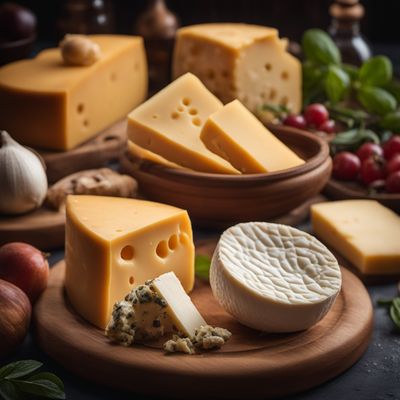
Colby cheese is a semi-hard cheese made from cow's milk. It has a pale yellow color and a smooth, creamy texture. The cheese is known for its mild flavor, which is slightly tangy and slightly sweet. It has a slightly elastic texture, making it easy to slice or shred. Colby cheese is often compared to cheddar cheese, but it has a milder taste and a softer texture.
Origins and history
Colby cheese originated in the United States in the late 19th century. It was named after the town of Colby, Wisconsin, where it was first produced. The cheese was created by Joseph F. Steinwand, a Wisconsin cheese maker, who combined the techniques of cheddar and Swiss cheese making to create a new variety. Colby cheese quickly gained popularity and became a staple in American households.
Nutritional information
Colby cheese is a good source of protein and calcium. It also contains essential vitamins such as vitamin A and vitamin B12. A 1-ounce serving of Colby cheese provides approximately 110 calories, 7 grams of protein, and 9 grams of fat.
Allergens
Colby cheese contains milk and lactose, making it unsuitable for individuals with lactose intolerance or milk allergies.
How to select
When selecting Colby cheese, look for a cheese that is firm and free from any mold or discoloration. The cheese should have a smooth and even texture without any cracks or holes. Opt for a cheese that has a fresh aroma and avoid any cheese that smells sour or ammonia-like.
Storage recommendations
To maintain the freshness and quality of Colby cheese, it should be stored in the refrigerator. Wrap the cheese tightly in plastic wrap or place it in an airtight container to prevent it from drying out. It is best consumed within a few weeks of purchase.
How to produce
While producing Colby cheese requires specialized equipment and knowledge, amateur cheese enthusiasts can try making it at home using cheese-making kits and following step-by-step instructions. However, it is recommended to start with simpler cheese varieties before attempting to make Colby cheese.
Preparation tips
Colby cheese is incredibly versatile and can be enjoyed in various ways. It can be sliced and eaten on its own, melted on sandwiches or burgers, grated over pasta dishes, or used as a topping for salads. When melting Colby cheese, it is important to do so over low heat to prevent it from becoming greasy.
Substitutions
A suitable substitute for Colby cheese is Monterey Jack cheese, which has a similar mild flavor and creamy texture.
Culinary uses
Colby cheese is commonly used in sandwiches, burgers, and grilled cheese sandwiches. It is also a popular choice for cheese platters, macaroni and cheese, and casseroles. Its mild flavor pairs well with fruits, nuts, and crackers, making it a versatile ingredient for appetizers and snacks.
Availability
Colby cheese is commonly available in the United States, particularly in the Midwest region. It is also produced and consumed in Canada.
More ingredients from this category » Browse all

Cheese, Monterey Jack
Monterey Jack: The Creamy Delight
Cheese, cheshire
The Quintessential British Cheese: Exploring the Delights of Cheshire Cheese
Cheese, provolone
The Melting Marvel
Cheese, gouda
Gouda: The Golden Gem of Cheeses
Cheese, jarlsberg
The Norwegian Delight
Cheese, fontina
Fontina: The Creamy Delight
Cheese, hushallsost
The Swedish Delight: Hushallsost - A Creamy and Nutty Cheese
Cheese, herrgardost
The Swedish Delight: Herrgardost Cheese
Cheese, double gloucester
Rich and Creamy Delight
Cheese, carrigaline
Irish Delight
Cheese, passendale
Passendale: The Belgian Delight
Cheese, kasseri
The Greek Melting Marvel: Kasseri Cheese
Recipes using Cheese, colby

Wisconsin Cheesy Stuffed Burger
Cheese Explosion Burger: A Taste of Wisconsin's Cheesy Delight
Pennsylvania Dutch Pane Frattau
Amish-inspired Pane Frattau: A Hearty Twist on an Italian Classic

Wisconsin-style Cheesy Scrambled Eggs
Wisconsin Cheese Delight: Scrumptious Cheesy Scrambled Eggs
Wisconsin-style Cheese-filled Salenjaci
Wisconsin Cheese Delight: A Twist on Bosnian Salenjaci